
Nearly a quarter of workers think AI is likely to replace them
23% of New Zealand workers think AI is likely to replace their job. What it means for a Copilot rollout, and what your people need to hear.
Nearly one in four New Zealand workers thinks AI is likely to replace their job within five years. The figure is 23%, from the Ipsos AI Monitor 2026, a survey of about 1,000 New Zealanders run in March and April 2026.
In the same survey, 57% of workers said AI tools had saved them time in the past year.
Both numbers describe the same workforce. People are using the tools, saving time, and still wondering what that time means for them.
A worry earlier software never carried#
Think back to 2020, when video meetings and chat landed on every desk within weeks. People grumbled about the notifications and the back-to-back calls. Nobody thought the meeting software was coming for their job.
Copilot arrived with that question attached. People were asked to learn it while the news told them, most days, how many jobs AI would remove.
With older software the complaint was that it was confusing. With Copilot the worry is personal, and that changes what a rollout has to do.
Training fixes a skills gap. It does nothing for a trust gap. A person who believes they are training their own replacement has no reason to try hard.
The worry is back where it was in 2023#
That 23% is not new. In the same survey it was 23% in 2023, 25% in 2024, and 19% in 2025. It is where it started.
The rest of this year's survey points the same way.
- 56% of workers expect AI to change how they do their job within five years.
- 58% of New Zealanders think AI will make the job market worse.
- 65% say products and services that use AI make them nervous. The share who say they are excited fell from 44% in 2025 to 40%.
- 59% say they use AI tools they do not fully trust.
Skills are a different story, at least where they have been measured. In this year's survey of AI use across government agencies, agencies reported lack of staff capability as a smaller barrier, for the first time.
So the skills gap is starting to close in government. The worry, across New Zealand, is where it was.
A treadmill or a ladder#
There is something I have noticed recently in how being more productive gets talked about. It is like putting people on a treadmill. The tools make them faster, so the message becomes go faster, then faster again.
I think that is the wrong message.
The other choice is a ladder: a way up to new opportunities.
Who is the productivity for? Does it create value for the organisation, or for the person doing the work?
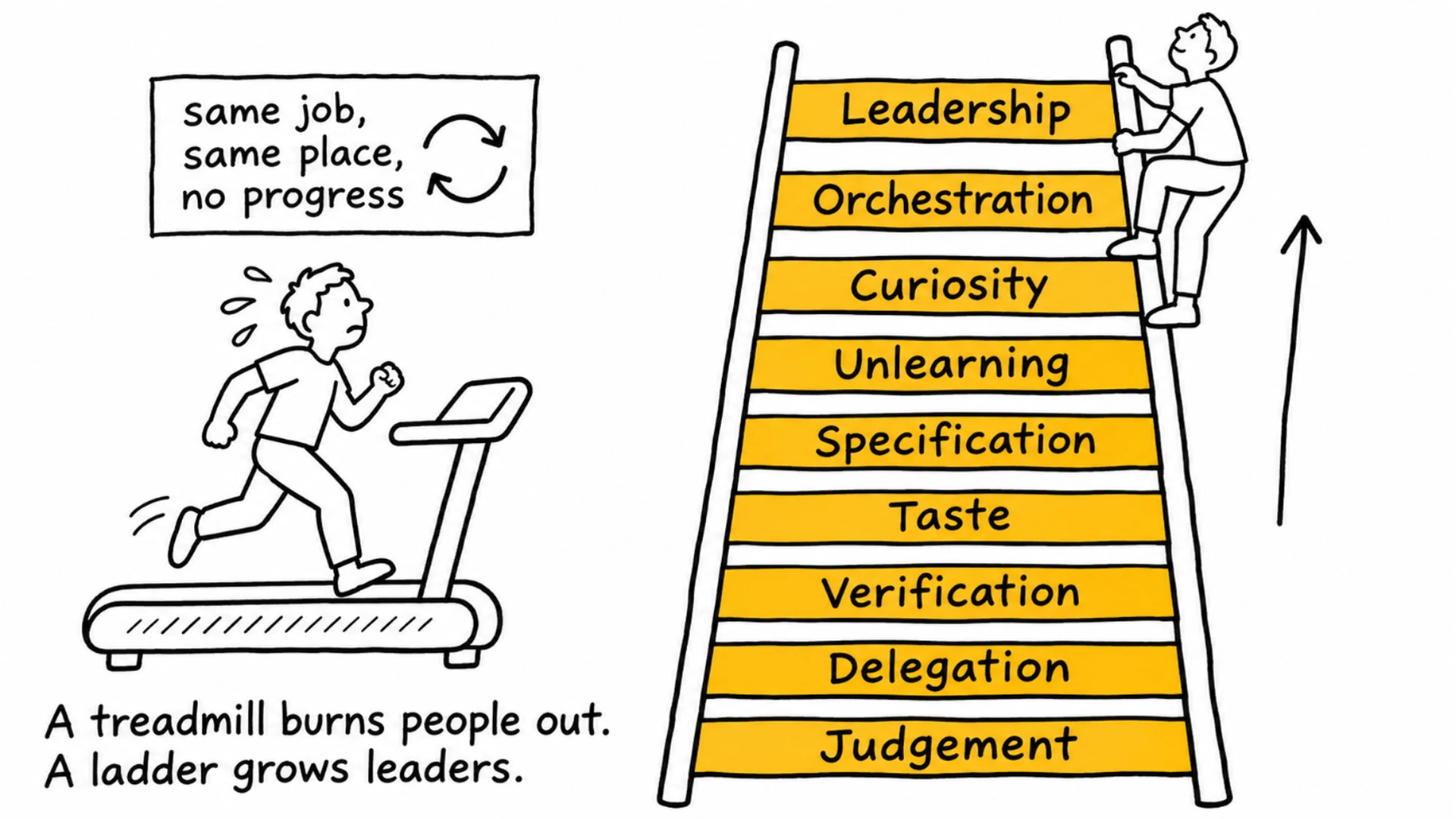
The treadmill is doing the same job, faster. Same job, same place, no progress.
The ladder is reinventing what the job means. It has nine rungs. I start at the bottom, with judgement.
- Judgement. Keep your brain switched on and evaluate everything: who is giving the message, why they are giving it, and whether an answer from AI feels right before you accept it.
- Delegation. Decide what to hand to AI and what to keep, and hand it over with enough direction to get something useful back.
- Verification. Check what comes back against the source before anyone relies on it.
- Taste. Know what good looks like in your own field, so you do not stop at the first draft that is merely acceptable.
- Specification. Say exactly what you want: the outcome, the standard it must meet, and the limits.
- Unlearning. Let go of the way you have always done a task when a better way is in front of you.
- Curiosity. Keep trying things, and keep asking what else is now possible.
- Orchestration. Run several pieces of work at once, some done by people and some by AI, toward one result that you still answer for.
- Leadership. Help the people around you up the same ladder.
Microsoft surveyed 20,000 people who use AI at work in ten countries this year. Asked which human skills matter more as AI takes on more, the two they named most were checking the quality of AI output, at 50%, and critical thinking, at 46%. Those are verification and judgement.
A treadmill burns people out. A ladder grows leaders.
What your people need to hear from you#
What happens to the time. If Copilot gives someone back three hours a week, who gets those hours? If the answer is "more of the same work", people work that out fast, and they stop reporting the hours. Decide before the rollout, and say it plainly.
What happens to the people. If your plan is to retrain people who already know your organisation and move them to work that needs them, say so, and show the first example. If you cannot promise that no role will change, do not promise it. Say what you do know.
Where to raise it. Give people a regular place to say "I am worried about my job" without it counting against them. A worry nobody is allowed to voice does not go away. It shows up as a tool nobody opens.
People get curious about a tool once they believe it is safe to.
Ask your people before the next training session#
Before your next Copilot training session, ask your people one thing: what do you think happens to the time this saves you?
Listen to the answers before you give yours.
Related reading
- Microsoft Copilot · Digital LiteracyYou have Copilot. Who showed you how to use it?I sat down with an owner and five of his own board papers. What Copilot drafted from them, and why I stopped him when the draft looked finished.
- AI LeadershipWhy AI upskilling is your most important leadership move in 2026New Zealand business owners who treat AI upskilling as a leadership priority, not a technical project, will make faster decisions and future-proof their growth.
- AI StrategyDesign principles for choosing and using AI toolsA practical framework for developing clear, defensible principles that guide how you choose and use AI tools, built from real experience rather than hype.